

A billion people can't be wrong
One in seven now live with mental illness, according to latest data

A billion is a number that is too big to comprehend. A thousand millions - or a million thousands. To count a billion of anything would require about 30 years - more if you need to stop for a toilet break or to eat a pear.
Take a billion humans for example. If you sat them on each other’s shoulders they would create a human pyramid tall enough to get to the moon. Five times. Though the ones at the bottom might be a bit shorter by the end. And the ones at the top might tend to float away a bit, but you know what I mean. And if you stood them shoulder to shoulder, with just enough personal space to dance a samba, they would fill the Greater London area.
This then, give or take, is the vast colony of people who are estimated to be suffering from some form of mental disorder. The latest figures, according to a global study published last week by the Institute for Health Metrics and Evaluation, puts the prevalence of cases at 1.17 billion. That’s one in seven people.
This prevalence has almost doubled since 1990 (while the population has risen about 50%). The figure for anxiety has risen almost 50% in the last five years.
“These rising trends may reflect both the lingering effects of pandemic-related stress and longer-term structural drivers such as poverty, insecurity, abuse, violence, and declining social connectedness,” said Dr Damian Santomauro, a lead author of the study
“Addressing this growing challenge will require sustained investment in mental health systems, expanded access to care, and coordinated global action to better support populations most at risk,” added Dr Santomauro, Associate Professor at the University of Queensland.
Remarkably, the amount of time lost to disability (known as the DALY) arising from mental illness peaks among teenagers. Meaning if we are to do any meaningful prevention it has to start young.


And the overall message is this: mental ill health may not be as deadly as cancer or heart disease. But it is now the 5th most debilitating condition in terms of the long stretches of time that people must just sit and languish.
This, for me, drives at the heart of the misery of mental distress. Because treatment is generally bad and recovery generally long, this is a family of conditions that really make people suffer. (My latest bout dragged on for about 15 months.)
As ever, the questions are the same: where has this come from? What is to be done? Some of the remarks I read in various forums included:
“These numbers are staggering, and the disability burden framing is the right one as this is not primarily a mortality story, it’s a years-lived-with-suffering story.” Jonathan Sunkersing
“Earlier prevention should be the focus, especially in (countries) like India, where mental health is largely ignored.” Prachi Sharma
“We often measure health systems by mortality reduction. Yet mental disorders remind us that years lived with disability may be one of the most underestimated metrics of system performance.” Roberto Llerenas
“This data reinforces something many of us in digital health are seeing firsthand: mental health demand is growing faster than traditional systems can respond.” Naved Ahmed Khan
And on this last point, I concur: I have long since feared that healthcare systems will never be mighty enough to treat such a vast preponderance of illness. Instead, people are learning the hard way that their best bet may well be their own resources: friendships, communities, activities, psycho-education, self-compassion, nature, self-knowledge, love.
I’ll be writing more about this through the summer.
The hot weather has once again prompted me to wonder: does climate affect our mental health? The answer seems to be yes, but… it’s quite complex.1 Light days are beneficial (I wrote about this last year), as are comfortable temperatures. Dark, gloom and cold are predictably negative. Strong winds can enervate. Extreme weather is stressful, even traumatic. 23
But very hot weather? There seems to be a correlation between heatwaves and higher rates of suicide and hospital admission for mental health problems. 4 5And interestingly, the Lancet report referred to above showed that the world’s hottest countries - in the middle East, the Sahel, Australia - suffered from some of the most debilitating mental illness. Though of course, that could be caused by other things.
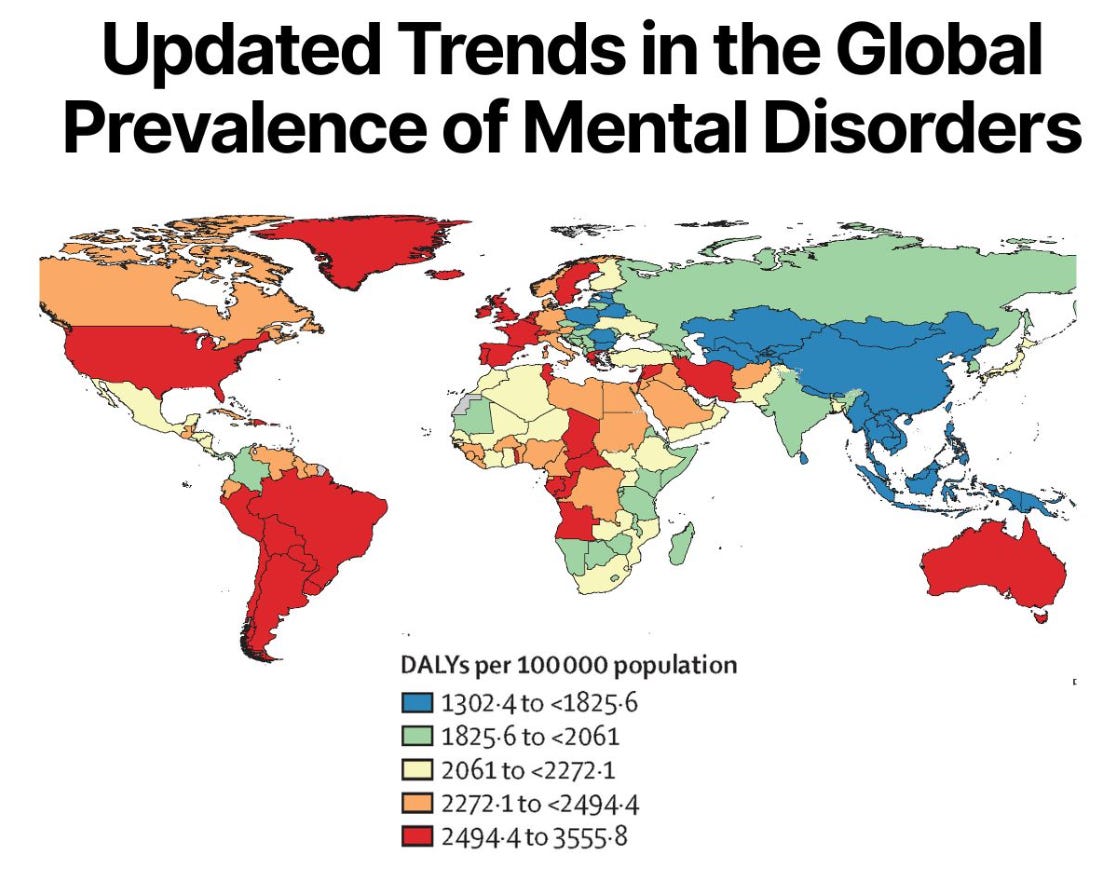
Personally, I love the heat. But if you don’t, these studies show that you are not alone.
Braindrops - weekly brain-teasers to test the mind (#47)
Can you crack this temporal lateral thinker?
It’s 1350. A deadly virus is sweeping Europe and no one is safe. People have been told to stay indoors, but there are still on average 20 deaths an hour across the country. A doctor trying to save people on an acute ward has counted seven deaths already today. What time is it?
Last week, the task was to find words that differed only by a single letter but mean more or less the same thing.
Did you get these?
_ _ _ _ _ _ (6) Fall TUMBLE
S _ _ _ _ _ _ (7) Fall STUMBLE
_ _ _ _ _ _ _ (7) Thoroughfare ROADWAY
B _ _ _ _ _ _ _ (8) Thoroughfare BROADWAY
_ _ _ _ _ (5) Pick ELECT
S _ _ _ _ _ (6) Pick SELECT
https://pmc.ncbi.nlm.nih.gov/articles/PMC7068211/#s4
https://pmc.ncbi.nlm.nih.gov/articles/PMC7699288/#sec4-ijerph-17-08581
https://pmc.ncbi.nlm.nih.gov/articles/PMC12272345/#sec10
https://www.thelancet.com/journals/lanplh/article/PIIS2542-5196(23)00104-3/fulltext#sec-4
https://pubmed.ncbi.nlm.nih.gov/20033251/
Thanks Mark another thought provoking article
The global figures are irrefutable, yet still we have a Cartesian dualism between mental and physical illness. This certainly contributes to the gross disparity of funding, although I agree with you that our current healthcare system just cannot cope with the size of the mental health problem.
One thing that stands out for me in your quoted change between 1990 figures and today is so barn door obvious that maybe it is overlooked. What has changed our lives beyond all recognition since the 1990s? The internet of course, and the overwhelming digitisation of our lives. I'm no Luddite, but it has to be a significant factor.