

1,000 Parkruns saved my life, says record breaker
Darren Wood was suicidal; running rescued him from despair

People deal with their demons in different ways. Some turn to Jesus, and some turn to heroin, as Joni Mitchell memorably sang. Some do the sensible thing and speak to a doctor and get medication or therapy or both. Some swear by nature or culture or meditation or transcranial direct current stimulation.
For Darren Wood, the answer was running. Darren ran and he ran. He ran so much that he ran into the record books. Last weekend, he became the first person in the world to complete 1,000 Parkruns1.
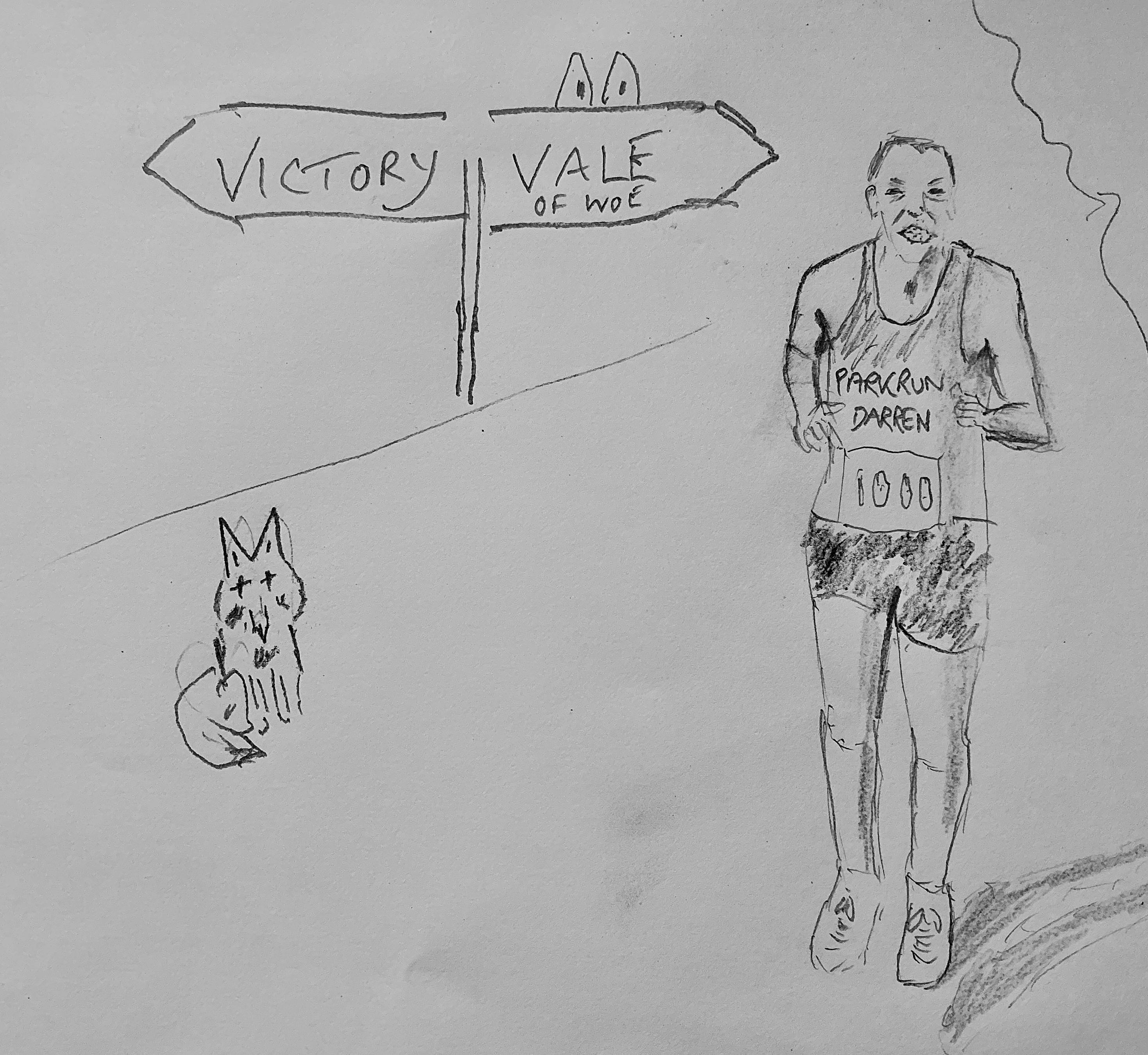
Now I have conflicted views about running. I don’t mind a quick dash to get from A to B, but I don’t see why I should run to get from A to A. Particularly when my knees feel like they are full of broken cogs from an abandoned Soviet trolleybus.
BUT… I do get it: the adrenaline, the endorphins, the freedom, the sense of agency. I used to run a little, and always felt better at the end than I did at the beginning.
Darren has always found this to be true. But he is far more enthusiastic about running than I am.
In fact, he says, it may have saved his life.
Darren has endured a lot through his 43 years. In some senses, his story feels familiar: a violent upbringing in an unsafe home; an abusive stepfather who once lunged at him with a carving knife. It is just remarkable how many people who go through childhood trauma end up with psychological pain as an adult.
But for Darren, things would get a lot worse. He escaped the tumult of his childhood home only to move into a marital home that was, if anything, worse. Domestic violence is overwhelmingly a crime perpetrated on women by men. But in Darren’s case, he was on the receiving end. His wife bit him, hit him, threw perfume and mirrors at him. Once, she bashed him on the head with a kayak paddle. On their honeymoon. Anything could set her off, Darren says.2
“I stuck with the marriage because I didn’t know what was normal,” he says. “But it started to take its toll. I started to get thoughts on the motorway like ‘I could just end this by driving into the central reservation’. Or when running on bridges I thought I could just jump off here.”
After he was made redundant, Darren did attempt to take his life by swallowing a random collection of pills. Nowadays, this rarely works, and a friend intervened before he could do himself too much physical damage.
(If these thoughts are upsetting or triggering for you, please speak to someone. Please do not adopt or enact these ideas: they are surprisingly bad ways to try to end your life and will likely just leave you - and other people - in a far worse state).
But psychologically, he was on the deep dark descent into the Vale of Woe. Darren started self-harming, cutting himself with knives, glass, anything. He went to support groups, took antidepressants, ended up deep in debt when he finally plucked up the courage to divorce his wife. (“I had a mental health assessment and was told you don’t have a mental health problem. You have a problem with your marriage.”)
And yet through it all, he kept doing the thing he had been doing since childhood: running. He took part in the second Parkrun in 2004, and never really stopped.
“It’s been the one stability in my life over the past 22 years,” Darren says. “It gave me purpose, routine, friendship, community. I am never judged and I am always welcomed to just be me.”
“That’s made a huge difference.”
Darren says running loosens his anxiety - but Parkrun is much more than that. It’s the companionship, the sociability, the fresh air and the immersion in the natural world. It’s the friendships you make on the opening lap, or beyond the finish line.
“I don’t feel as uptight when I come back from a run,” he says. “You let everything go. There’s a social element, you talk, you get things off your mind.”
Since that first outing 22 years ago, Darren has run in 119 different Parkrun events in five different countries - the UK, US, Poland, Denmark and Sweden. Number 998 was in Copenhagen, and number 999 was in Växjö, Sweden. He has run on 19 Christmas days and plenty of January 1s as well. He says he is a participant, not a competitor, but he’s no slouch either, with a personal best of 17m58s in 2007 for the five-kilometer course.
One Christmas, post-divorce, Parkrun was the only moment of joy in a lonely day. “I wasn’t able to see the kids, so it was the one bit of interaction with other people I had.”
After his 1,000th run in south London last Saturday, Darren gave a speech encouraging others to get involved, particularly if they are lonely .
“It will change or save other people’s lives,” he tells me, “just like it saved me.”
Darren’s speech after his 1,000th Parkrun…
Braindrops - weekly brain-teasers to test the mind (#48)
Another lateral thinker this week…
In the civil war, the United States was a nation bitterly divided over issues such as oppression, freedom, and the senselessness of the conflict itself. As many as 3 million people lost their lives. But the vast majority were not American. Who were they?
Last week was just as deliberately misleading…:
It’s 1350. A deadly virus is sweeping Europe and no one is safe. People have been told to stay indoors, but there are still on average 20 deaths an hour across the country. A doctor trying to save people on an acute ward has counted seven deaths already today. What time is it?
Answer: the time is 1:50pm. If there is a doctor on an acute ward, this cannot be the year 1350 that we are talking about. So the only reasonable assumption is that it is a more recent illness, and 1350 refers to the time.
That’s all for now.
I’m away next week but back with you in mid-June.
Mark
Parkrun is a free social 5k event that was launched in 2004 and now takes place at more than 2,000 locations in 23 countries.
Headstrong has been unable to speak to Darren’s ex-wife, so is only able to report his side of the story.