

Why is everything the same?
What happens psychologically when we all conform?

Occasionally, you read something that stops you in your tracks. A piece that confirms something that you have known for a long time to be true, without quite making sense of it.
A piece that you wish you’d written yourself.1
This happened to me recently. This article by Adam Mastroianni argues that in recent years we have slumped into a recession of imagination and ideas. Art, culture, style, music, film, architecture, journalism, books, even people themselves, have become straight, boring, repetitive, conventional.
No one exists outside of a narrow channel of conformity. Nothing is weird. Culture is stuck.
If you think this is a weird thing to say, then I take that as a compliment.
But ask yourself: when was the last time you watched something genuinely different and surprising on television? That didn’t involve someone being voted off a show or ‘going on a journey’? When was the last time you saw a new film that broke the superhero/jeopardy/all-comes-good-in-the-end mould? Or read a new book that didn’t involve a murder, some dogged detective work and a fairly predictable twist.
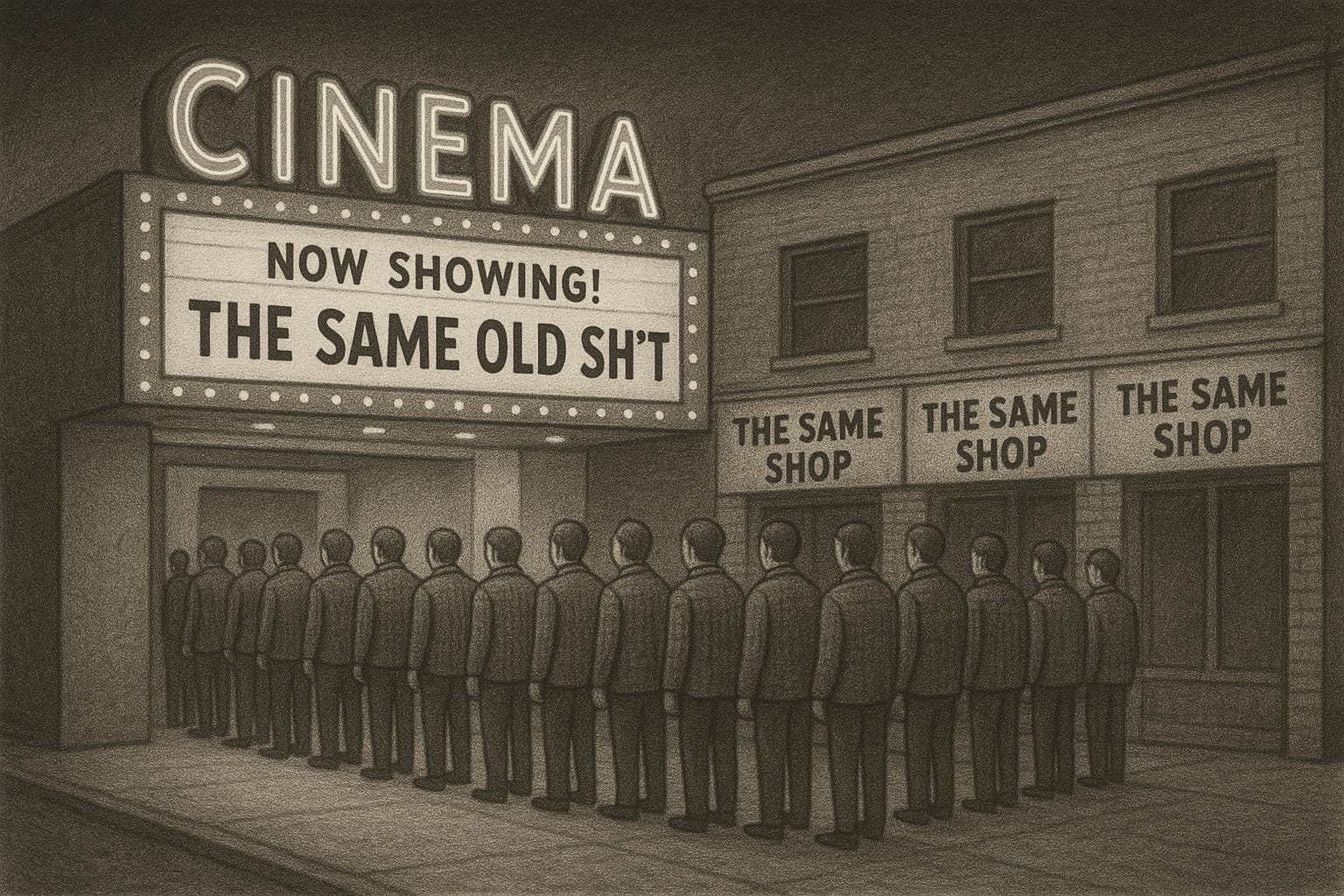
Who do you know who is different - and celebrated for being so?
It’s not for me to repeat Adam’s words here: read them for yourself at the link above.
What I do want to do is ask the question I always ask when I come across a new idea: what impact, if any, does it have on our collective wellbeing?
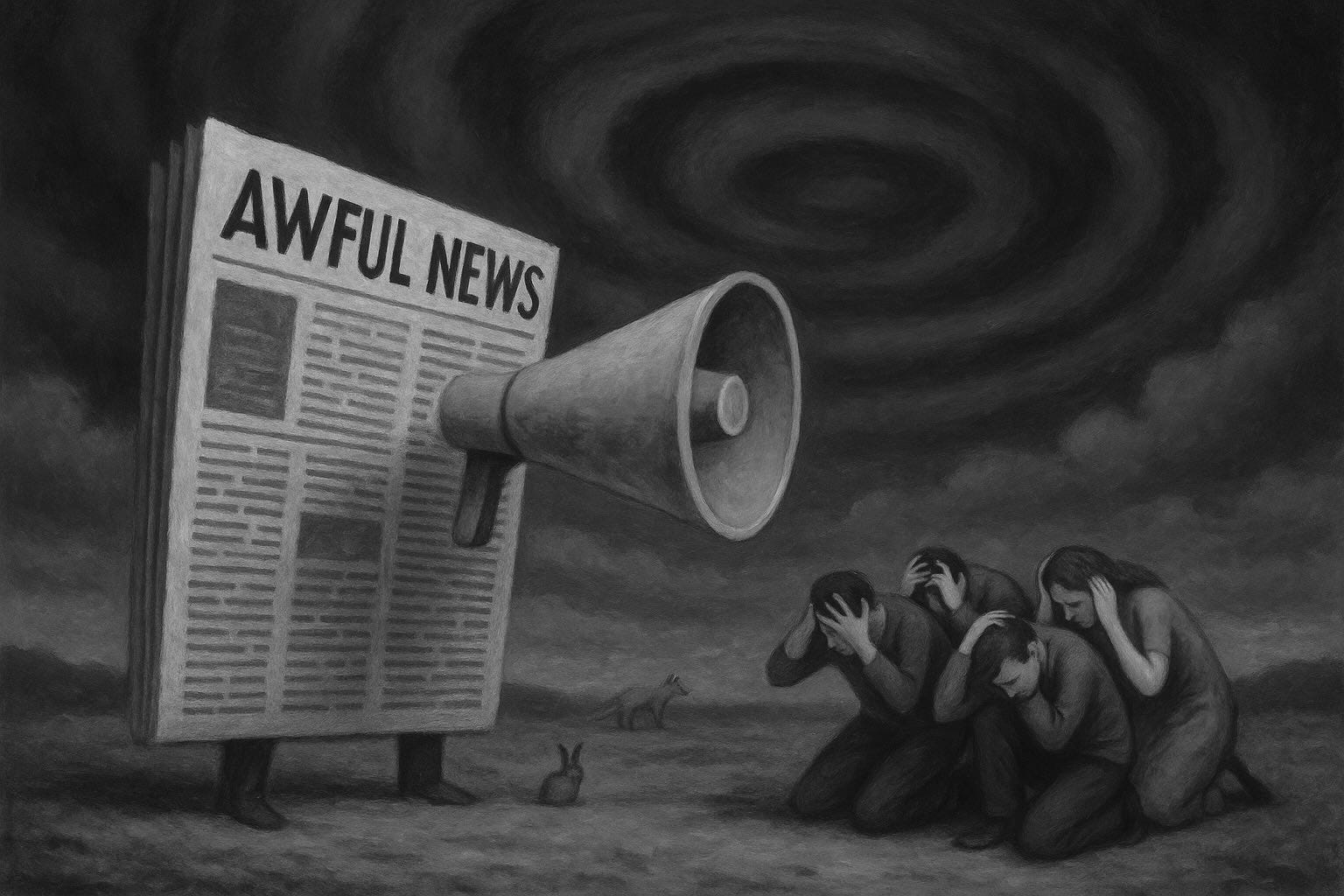
We have persuaded ourselves that our mental health is in the doldrums. We blame it on technology, on awareness, on capitalism. We point the finger at The News, loneliness, work or the lack of it, the fall of religion and the rise of expectations.
But could something far more subtle be at play? For 30 years the world has flattened into homogeneity. From the streets where we shop to the clothes we wear and the cars we drive, the furniture we own and the offices we work in. Perhaps food is an exception, but an exception that proves the rule.
It used to be good to stand out. Now everyone wants to fit in. What does that say about us? There must be an effect of all that conformity on our psyches. When I was a teenager, it was still possible to rebel. Hair was dyed or grown horribly long, piercings were thrillingly radical, alcohol and drug use subversive, foreign travel exotic.
Nowadays even neck tattoos are mundane, everyone has been to Mexico and we are all cutting back on the booze. Newspapers copy each other’s stories, sometimes literally.
I may be on dodgy ground here. There isn’t a whole lot of research on this. One paper I read argues that excessive conformity can lead to lower self-esteem and lower sense of agency.2 But another says that while conformity can limit self expression and personal growth, it provides comfort amid the crowd.
So I’m going to hazard my own theory. A world of copycat culture is dull and depressing and makes it less thrilling to be alive; a world devoid of difference leaves nowhere for our imaginations to roam. The rise of a homogenised beauty - a standard way of looking championed by platform algorithms - makes it miserable to be ‘interesting’.
A uniform world brings all colour back to grey, and that is sad for our eyes. A world where it’s important to fit in is an insecure place that denies us our very special individuality and ability to be ourselves. It’s a world where we are constantly being judged and appraised.
None of that is good for our self-esteem. In this world you become acutely aware of your differences and ‘shortcomings’; and if you are one to internalise and catastrophise, well it’s a short hop from there to mental discomfort.
Do you agree that culture is stagnant and conformity paramount? Do leave your thoughts in the comments - particularly if you disagree…
Meanwhile, there are two things coming down the track that threaten to impose even more monochrome uniformity on our greyscale world.
Artificial intelligence seems designed to scrape up all the stuff we already know and reflect it back to us as if it is new and original. It isn’t. It cannot make our hearts soar.
But even before that, we are heading into that most unoriginal time of year, when the only thing you’re allowed to listen to is the Christmas playlist and the only thing you’re allowed to feel is jolly and nostalgic, or jolly nostalgic.
For the sake of our collective mental health, I wish you a very varied Christmas.
Braindrops - weekly brain-teasers to test the mind (#29)
In the interests of uniformity, Braindrops goes back to its standard puzzle this week. These two words are almost homogenous, apart from the letter shown. What are they?
_ _ _ _ E (5) Space
_ _ _ _ S (5) In space
Last week. Did anyone bother with last week? Three pairs of countries that share several letters. It was quite hard, I’ll grant you that. Here are the answers:
First pair:
1 - 2 - 3 - 4 - 3 - 5 SWEDEN
4 - 3 - 5 - 6 - 7 - 8 - 9 DENMARK
Second pair:
1 - 2 - 3 - 4 - 5 - 6 - 7 GERMANY
1 - 3 - 2 - 6 - 5 - 8 - 5 GRENADA
Third pair
1 - 2 - 3 - 4 - 5 - 6 GUINEA
4 - 3 - 1 - 5 - 7 - 3 - 6 NIGERIA
Anyone get three out of three?
Next week: Headstrong’s interviewees on how the year has treated them.
Until then
Mark
I know - this happens to you every week when you read Headstrong
https://pmc.ncbi.nlm.nih.gov/articles/PMC4873518/#sec12
There's an interesting paradox at play here. On one hand, especially for young people, there can be great security in fitting in, being one of the crowd. Standing out can be seen as original, creative, daring, but of course that can backfire leaving the person ostracised and made fun of.
As we mature I think there's a tension between wanting to be different, perhaps a bit edgy, a bit radical, but at the same time keeping enough of oneself in touch with the mainstream. Work life can exacerbate these tensions - I know that as an NHS consultant I was regarded as 'different' (not always in a good way) for things as simple as sending my children to state rather than private schools.
Then there's the absence of sameness and conformity that occurs with madness. I remember the dizzy sense of having almost superhuman properties that comes with hypomania, and equally the sense of exclusion from the rest of society that accompanies depression.
So I'm not sure this is an all or none issue. I'd suggest that a certain degree of conformity/ sameness is necessary to enable some of us to be creative. It acts as an anchor for creativity rather than a block on it.
I just want to add that if anyone has seen a recent movie that is different, mysterious, out-of-the-ordinary, please do recommend. I’m tired of the same formula.